

Conversion-optimized checkout
Fewer steps, fewer abandoned carts: checkout flows designed to reduce friction at every stage
Scalable product catalogs
Manage thousands of SKUs with variants, filters, and search that stays fast at any scale
Subscription & billing logic
Recurring payments, trials, upgrades, and downgrades, handled cleanly so customers stay longer

Smart Product Discovery
Faceted search, personalized recommendations, and dynamic filters surface the right products faster
Flexible Payments
Stripe, PayPal, and local gateways, with support for split payments, installments, and multi-currency
Inventory & Fulfillment
Real-time stock levels, warehouse routing, and shipping integrations keep fulfillment predictable
Analytics & Optimization
Track funnel drop-offs, A/B test layouts, and measure what actually drives revenue
Built on the stack your business needs
We connect your storefront to the tools that run your operations: payments, shipping, CRM, analytics, and more.

Browse like a local, shop from anywhere
Localized storefronts with multi-currency and multi-language support built in
Manage everything in one place
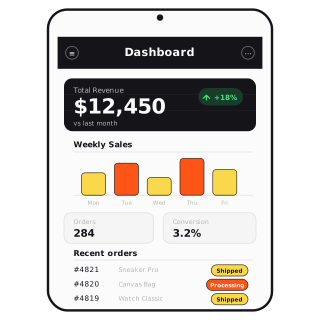
Unified dashboards for orders, inventory, customers, and revenue — no tab-switching required
Conversion is an engineering metric
Most conversion problems aren't copywriting problems — they're seconds and steps. A storefront that paints its largest content fast, a checkout that survives a payment error without losing the cart, address autocomplete that works for European formats, saved payment methods that actually save: each one is a small engineering decision, and they compound into the conversion rate.
So we treat the funnel as an instrumented system. Drop-off is measured per step, hypotheses get A/B tested rather than debated, and performance budgets are part of the definition of done. When the data says a layout loses revenue, the layout loses the argument.
Platform or custom: an honest decision framework
Shopify covers most retail use cases brilliantly, and as official Shopify Partners we say that without hedging. The case for custom starts where your model diverges from retail defaults: B2B pricing matrices, marketplace mechanics, subscription logic with real edge cases, or margins that make per-transaction platform fees hurt.
The framework we walk clients through is total cost of ownership against differentiation: pay a platform for the parts of commerce that don't differentiate you, build custom only where your business logic is the product. Often the answer is hybrid — a headless storefront on platform rails — and sometimes the honest answer is "don't build, configure".
Commerce is going agentic
The next storefront visitor may be an AI agent shopping on someone's behalf. That changes what "optimized" means: clean structured product data, schema.org markup, stable APIs, and machine-readable availability stop being SEO niceties and become the sales channel itself. Our Commercy.ai work — AI product search for Shopify — sits exactly on this shift.
Preparing is unglamorous: fix the product data, expose the catalog through consistent APIs, mark up prices and stock so machines can trust them. Stores that are easy for agents to read will be the ones agents recommend — the same way fast, crawlable sites won the last decade of search.
Commerce we've shipped
The stack we reach for
- Shopify & Shop Minis
- Next.js & React
- Stripe & PayPal
- Node.js
- Headless CMS
- Analytics & A/B testing
Frequently asked questions
Shopify or custom — which should we choose?
Both have their place. We're official Shopify Partners and we build fully custom storefronts and SaaS products. The honest answer depends on your catalog complexity, margins, and integrations; if a platform is enough, we'll tell you.
Can you migrate our existing store without downtime?
Yes. We migrate catalogs, customers, and order history in stages, run both systems in parallel, and switch traffic only when parity is verified.
How do you handle subscriptions and billing edge cases?
Trials, upgrades, proration, dunning, and multi-currency are designed into the billing model from the start, not patched in after the first failed renewal.
What does an e-commerce build cost, and how long does it take?
A focused storefront ships in 6–10 weeks; platforms with custom logistics or subscription logic take longer. We scope a fixed estimate after a discovery call.
A storefront that pulls its weight.
A platform that absorbs complexity quietly leaves customers buying and your team building instead of firefighting.
Ready to level up your e-commerce?
Describe your product and how you sell it. We'll propose the setup we would build, platform or custom.
Contact usFrom the blog
Your store can now sell inside ChatGPT. Here's what Shopify's Agentic Storefronts actually change.
Shopify's Winter '26 Edition lets merchants sell directly inside ChatGPT, Copilot, Google's AI Mode, and Gemini. The buyer never lands on your site, which changes what you actually need to get right.
Shopify Scripts stop running on June 30. If you haven't moved to Functions, checkout breaks.
On June 30, 2026 every Shopify Script stops executing. Plus stores running custom discount, shipping, or payment logic in Scripts will see it silently fail unless it's been rebuilt as a Function first. Here's what breaks and how to scope the move.

SEO for AI agents: why answer-engine optimization is the new SEO
Search is being rewritten by ChatGPT, Claude, Perplexity, and Gemini. Here's what actually moves the needle when the thing ranking your content is an LLM, not a search index.