HIPAA & GDPR-ready architecture
Built from the ground up to meet privacy and security requirements for health data, on both sides of the Atlantic
Patient-centered UX
Interfaces designed around real clinical workflows, not generic dashboards forced onto medical staff
Interoperability first
HL7, FHIR, and standards-based integrations so your systems talk to each other without workarounds

Secure Data Exchange
Patient records, lab results, and prescriptions move between systems using encrypted, auditable channels
Access Control
Role-based permissions ensure only authorized personnel see sensitive information
Appointment & Workflow Automation
Reduce manual scheduling, intake forms, and follow-ups with rules-driven automation
Audit Trails
Every access and change is logged for compliance reviews and incident response
Designed for the systems you already use
We integrate with EMR, EHR, lab systems, telemedicine platforms, and billing, using FHIR, HL7, and secure API patterns.
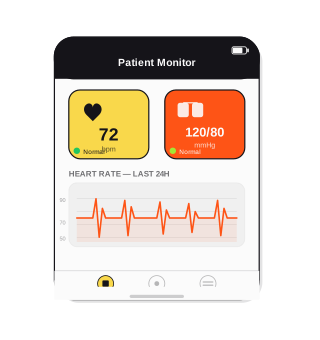
Monitor vitals, track trends
Real-time dashboards give clinicians a clear view of patient health over time
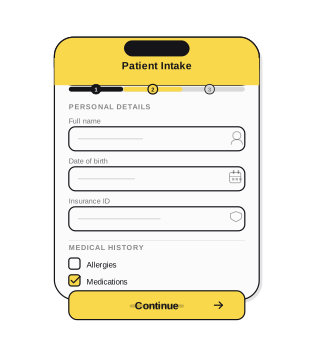
Streamlined intake, faster care
Digital forms and automated triage reduce wait times and administrative overhead
What HIPAA-ready architecture actually means
Compliance is mostly boring discipline applied early. Encryption at rest and in transit is table stakes; the work is in the details — role-based access that mirrors real clinical roles, append-only audit trails that can answer "who saw this record and when", session policies that respect how clinicians actually move between workstations, and a BAA chain that covers every subprocessor that touches PHI.
The reason to design this in from day one is cost: retrofitting audit logging or access controls into a system that wasn't built for them means touching every endpoint. Our healthcare builds start from a compliance skeleton — environments, logging with PHI redaction, access reviews — and grow features on top of it, not the other way around.
US and EU: building for two regulatory worlds
HIPAA and GDPR overlap less than people assume. HIPAA scopes to PHI held by covered entities and their business associates; GDPR covers all personal data, with consent and erasure rights HIPAA doesn't contemplate. Breach timelines differ, contractual instruments differ — BAA versus DPA — and the EU is layering on EHDS for health-data sharing.
One architecture can serve both markets if data flows are explicit from the start: per-region storage so residency is a deployment choice rather than a rewrite, consent modeled as data rather than as a checkbox, and deletion paths that actually delete. We've built for both regimes, and the pattern holds.
Interoperability without the integration graveyard
FHIR and HL7 are standards the way dialects are a language — every EMR vendor implements a subset, a version, and a few surprises. The integrations that survive are built as adapters with queues between systems, tested against vendor sandboxes, and designed to degrade gracefully when the other side is down or slow.
We treat integration as a product feature, not plumbing, because clinicians won't re-key data and shouldn't have to. If the referral, the lab result, or the prescription doesn't flow automatically, the workflow falls back to fax and the platform loses the room. Integration scope gets budgeted first-class in every healthcare engagement.
Healthcare we've built
US government healthcare programs
Much of our healthcare work is HIPAA-compliant platforms for American public-sector programs. Those projects are under NDA (which is exactly how clients in this space want it), so the names stay private while the compliance experience carries into every build.
The stack we reach for
- FHIR & HL7
- HIPAA-eligible cloud (AWS)
- PostgreSQL
- React
- Node.js
- Audit-grade logging
Frequently asked questions
Have you built HIPAA-compliant systems before?
Yes. A substantial share of our healthcare work is for US government healthcare programs. Those projects are under NDA, so they don't appear in our public case list, but the architecture patterns, audit practices, and compliance experience come with us to every engagement.
Is the software HIPAA and GDPR compliant?
We build to the regulations your market requires: HIPAA for the US, GDPR for the EU. Encryption at rest and in transit, role-based access, audit trails, and data-residency controls are part of the architecture, not an add-on.
Do you sign BAAs and DPAs?
We do: as a Business Associate where HIPAA applies, and as a data processor under GDPR with a data processing agreement.
Can you integrate with our EMR/EHR?
Yes. FHIR and HL7 are our default integration paths, and we work with the APIs of common EMR, lab, and billing systems.
Where is patient data hosted?
Wherever compliance requires: EU-resident hosting for European deployments, US regions for HIPAA-covered entities. Your data-residency requirements drive the architecture, not the other way around.
How long does a healthcare build take?
Longer than a typical web product, deliberately: compliance review, audit logging, and integration testing are part of the schedule. Expect roughly 3–6 months to a first compliant release, scoped after discovery.
Software clinicians don't fight with.
When the system fits the clinic, patients feel it: shorter waits, fewer errors, better follow-up.
Ready to modernize your healthcare platform?
Walk us through your compliance requirements and clinical workflows. We'll come back with an architecture that fits both.
Contact us