Real-time device monitoring
Live telemetry from every connected device: status, health, and alerts at a glance
Edge-to-cloud architecture
Process data where it matters: at the edge for speed, in the cloud for scale and analysis
Secure by design
Encrypted communications, firmware signing, OTA updates, and access controls built in from day one
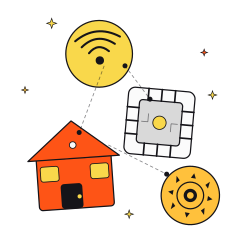
Device Provisioning
Automated onboarding, configuration, and firmware management for fleets of any size
Data Pipelines
Ingest, transform, and route telemetry to storage, analytics, and alerting systems in real time
Rule Engines
Trigger automations, alerts, and device actions based on thresholds, schedules, or complex conditions
Dashboards & Control
Visualize fleet health, drill into individual devices, and send commands, all from one interface
Integrates with your hardware and cloud stack
We work with major IoT protocols and cloud platforms (MQTT, CoAP, AWS IoT, Azure IoT Hub) and connect to your existing infrastructure.
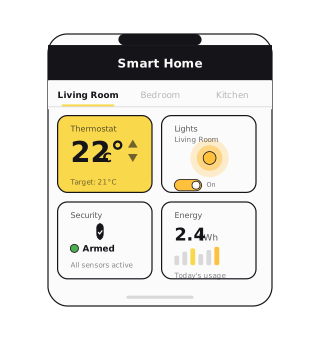
See every device, control every room
Unified dashboards give operators real-time visibility across floors, buildings, or entire deployments
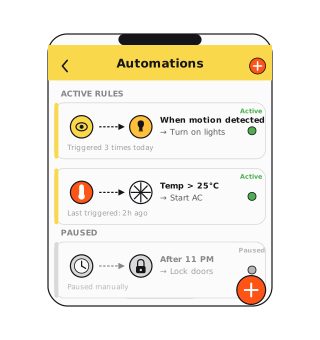
Automate the routine, alert on the exception
Rules engines handle repetitive tasks while smart alerts surface only what needs human attention
From sensor to dashboard without losing data
Field devices live on bad networks, and the pipeline has to assume it. Edge buffering with store-and-forward means a connectivity gap costs latency, not data. Idempotent ingestion means the same reading arriving twice doesn't double-count. Late and out-of-order data is the normal case, not the exception — so timestamps come from the device, clock drift is corrected, and the time-series store is chosen for the query patterns the dashboards actually need.
Backpressure is the part teams discover in production: when a thousand devices reconnect after an outage and replay their buffers at once, the ingestion layer either absorbs the burst or falls over. We design for the reconnection storm on day one, because it always comes.
Fleet operations: provisioning, OTA, and the day-two problem
Getting one device online is a demo; getting ten thousand online — each with its own cryptographic identity, certificate rotation, and a way to revoke a compromised unit — is the product. Provisioning has to work at the factory and in the field, without a technician typing credentials into anything.
Firmware updates are where fleets are won or lost. Staged rollouts with automatic rollback mean a bad build reaches one percent of devices, not all of them. After launch, the platform's real job is the day-two routine: fleet health at a glance, rule engines automating the repetitive responses, and alerts tuned so humans only see what genuinely needs a human.
Security and the EU Cyber Resilience Act
If you sell connected products in the EU, the CRA turns security from a virtue into a legal requirement: secure-by-default configuration, a vulnerability-handling process, and security updates for a defined support window. The deadlines are close enough that products being designed today will ship into the enforcement period.
The good news is that CRA compliance and good engineering are the same list: signed firmware, encrypted transport, OTA infrastructure, an SBOM you can actually produce, and a way to ship a patch quickly when a CVE lands. We build that in from the first board bring-up — retrofitting it onto a shipped fleet is the expensive version.
IoT we've shipped
The stack we reach for
- MQTT & CoAP
- AWS IoT
- Azure IoT Hub
- LoRaWAN & NB-IoT
- Custom firmware & OTA
- Time-series storage
Frequently asked questions
What hardware do you work with?
We're hardware-agnostic: off-the-shelf sensors, custom boards, and everything in between. If it speaks MQTT or CoAP, or even just has a serial port, we can bring it online.
Can you retrofit devices we already have in the field?
Usually, yes: through gateway devices or firmware updates with OTA support, so existing fleets join the platform without recalls.
Which connectivity options do you support?
WiFi, Ethernet, LoRaWAN, NB-IoT, and cellular, chosen per deployment based on power budget, range, and data volume.
Who owns the data?
You do. We build on your cloud accounts (AWS IoT, Azure IoT Hub, or self-hosted), so telemetry, models, and dashboards stay yours.
Does the EU Cyber Resilience Act affect our product?
If you sell connected devices in the EU, yes: the CRA sets requirements for secure updates, vulnerability handling, and support windows. We design for it from day one rather than retrofitting compliance later.
Data you can trust, from devices you can manage.
When the platform handles connectivity and scale, your team gets to think about what the data means instead of how to fetch it.
Ready to connect your devices?
Describe your hardware and use case. We'll map the path from sensor to dashboard.
Contact us